

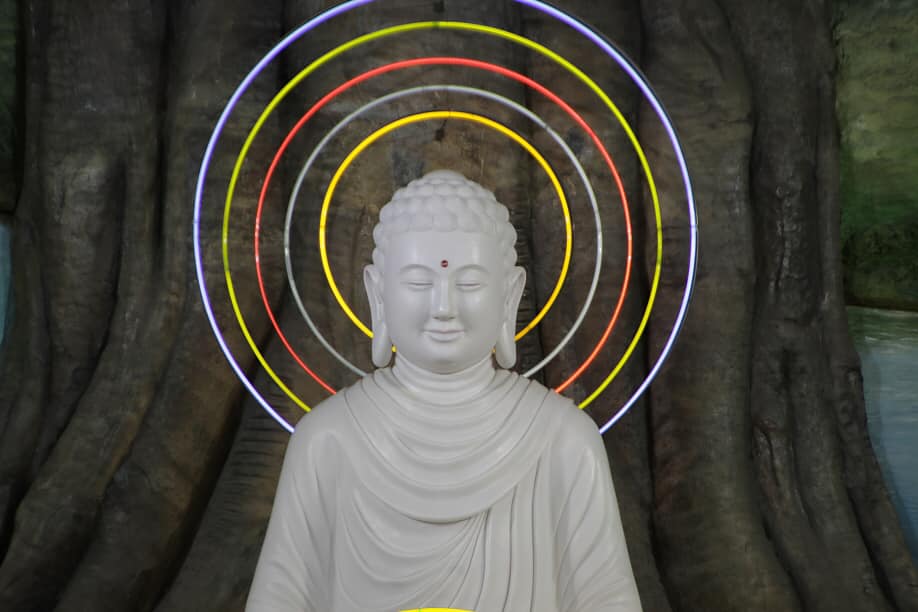
Does meditation belong to Buddhism or religion?
When talking with many people about meditation, one of the the most common misconception that we have noticed is: meditation belongs exclusively to Buddhism. Many people believe that if you meditate, you must be a Buddhist. Or that if you follow another religion, such as Christianity, you are not allowed to meditate. Others think that meditation in Buddhism is a strongly religious practice reserved for a group with particular beliefs.
In fact, this is not entirely true.
Shakyamuni Buddha, also called Siddhartha Gautama, attained enlightenment through inner practice. Although Buddhism has as many as 48,000 Dharma methods, many scriptures and meditators' experiences show: meditation is the important practice that led Him to enlightenment and becoming a Buddha.
For this very reason, many people have assumed that meditation in Buddhism is the only path, and meditation belongs to Buddhism.
However, the truth is meditation emerged before the Buddha's time. It is a inherent innate nature in human beings. Many teachers and people of spiritual depth practiced meditation before the Buddha's time. And of course, after his time, other enlightened people continued to emerge through various meditation methods.
Therefore, it must be clearly understood: meditation is not the exclusive property of Buddhism.
Even so, it cannot be denied that meditation in Buddhism is a special, systematic spiritual practice. The Buddha's meditation differs from other methods. It can be called “Buddhist meditation” — taught by the Buddha and recorded in the Buddhist canon.
But even so, almost all meditation methods, Buddhist or otherwise, nonsectarian. There is no restriction that only Buddhists may meditate, or that followers of other religions cannot.
The truth is:
- If you atheist, you can still meditate.
- If you have religious faith, you can meditate.
- If you are Buddhist, you can meditate.
- If you follow the religion of Christianity, you too can meditate.
- If you are Islam, you can still meditate.
Even, prayer – a common activity in religions – also has a nature similar to meditation. When you pray, you connect with God, with some sacred energy outside yourself. When you meditate, you connect with the universe within yourself – that is also a part of God.
Prayer is converse with God. Meditation is listen to God.
The meditation techniques makes no religious distinctions. Meditation is not the brand of religion A or B. Meditation is a method transcending all religious boundaries.
Anyone can meditate
We all suffer. Whatever your religion, you suffer over love, work, money, illness… Those pains are humanity's shared pain. And meditation is a medicine shared by everyone.
Meditation in Buddhism or any other form of meditation aims to transform suffering, helping people return to inner stillness, understanding, and love.
People of any religion can meditate. People with no religion can meditate. Anyone can meditate.
The truth: Meditation is your innate nature
Meditation in Buddhism or any other form of meditation is not a technique learned externally. Meditation is something already exists within you. The teacher, however great, also is only someone who reminds you of that.
When you were born, no one taught you to breathe—yet you knew how.
Likewise, you were born with stillness already within you — you simply forgot.
You do not need to yearn for enlightenment or become a Buddha before you can meditate. Meditation can simply be:
- One quiet minute amid a busy day
- Five minutes of relaxation after stressful work
- An evening of steady breathing before sleep
- Fifteen minutes sitting quietly in a park, simply observing the breath
Meditation requires no elaborate rituals, special clothing, mountain retreat, or seclusion.
As long as you want listen to yourself, you can meditate.
Meditation in Buddhism – a path to enlightenment, not exclusively for Buddhists
It cannot be denied that in Buddhism, meditation is the core. It is not only a method but also a path toward insight and liberation from suffering.
But the important thing to remember is: whether or not you are Buddhist, you can still practice meditation in Buddhism and receive immense benefits.
Because meditation is your essence, your innate nature.
If you can breathe—you can meditate.
Because you are human—you have the right to return to yourself.
Discover Awakening Meditation – A Journey Back to Yourself
Explore the journey, thinking, and special role of Teacher Tạ Minh Tuấn — who teaches the method of Awakening Meditation helps thousands rediscover themselves.
Who is Teacher Tạ Minh Tuấn?
Teacher Tạ Minh Tuấn is a entrepreneur, educator, and spiritual guide in Vietnam. Before teaching Awakening Meditation, the Teacher was a pioneer in the entrepreneurship movement, founding many organizations for education and consciousness development, seek life purpose truly.
However, from the peak of his career, the Teacher chose step out of the spiral of external achievement, to turn inward, practicing meditation and intensive spiritual cultivation from many ancient traditions combined with modern knowledge. This journey helped the Teacher profound transformation, leading to the founding of the Awakening Meditation method – nonreligious and free of superstition, yet grounded in practicality, science, and authentic spirituality.
“The Teacher is someone who has passed through both the light and darkness within himself, to become a bridge between modern wisdom and ancient insight.”
Journey and mission
After many years of learning and deep meditation practice across Buddhist schools, mindfulness meditation, psychology, energy medicine, and quantum science, Teacher Tạ Minh Tuấn has synthesize the essence of many wisdom traditions to teach the Awakening Meditation method.
What is the Awakening Meditation Method?
Awakening Meditation is the combination of:
- Meditation: helps calm the mind, master breathing, and return to the present.
- Insight Meditation: observe deeply within, unravel traumatic memories, karmic forces, and attachments.
- Life applications: such as dream interpretation meditation, emotional transformation meditation, energy healing meditation, quantum verification…
This is the meditation method suitable for modern people, especially for those seeking:
- A method simple yet profound meditation
- A journey spiritual freedom free from dogma
- A community live mindfully, heal, and develop inwardly together
Materials and tools supporting your meditation journey
📚 Meditation Books by Teacher Tạ Minh Tuấn
- Anyone Can Meditate – A simple, understandable book for beginners, introducing meditation and its practical applications in life.
- The Journey of Awakening – A book guiding those seeking true happiness and deep understanding of themselves, life, and spiritual awakening.
🛒 Order at: https://books.inti.foundation/
👥 Awakening Meditation Zalo Community – https://zalo.me/g/svgwbk619
A community supporting meditation practice, sharing experiences, and offering guidance from the SoulCoach team — those who have walked ahead on the journey of healing and awakening.
Conclusion
Meditation in Buddhism is not the exclusive product of any religion. It is a profound method that helps you reconnect with yourself, listen to your inner universe and heal suffering.
No title or religious background is required.
No temples or highly accomplished teachers are required.
As long as you are still breathing—you can meditate.
Meditation is not reserved for an elite minority.Meditation is for everyone. Anyone can meditate.
Khóa học liên quan tại Inti School: 7-Day Awakening Meditation
Thiền Phật giáo có phải chỉ dành cho Phật tử không?
Không nhất thiết. Người mới có thể bắt đầu bằng việc quan sát hơi thở và phản ứng của mình trong một thời lượng ngắn, đồng thời tôn trọng bối cảnh của pháp thực hành thay vì tự gán cho mình vai trò giảng dạy.
Một cách bắt đầu có giới hạn là: ngồi yên hai phút, nhận biết một hơi thở và một cảm giác, sau đó ghi lại điều mình đã quan sát mà không suy diễn. Bạn có thể xem lộ trình Phật pháp 7 ngày công khai và tự chọn nhịp phù hợp. Nội dung này không thay tư vấn y khoa, tâm lý, pháp lý hay tài chính.